
Introduction
Which is colder: minus 40°C or minus 40°F? Neither. They’re the same temperature. At exactly −40, the Celsius and Fahrenheit scales meet, and no other number does that.
That’s why this question trips people up. Two different scales, one identical reading.
Below, I’ll show you the quick math, give you a Celsius to Fahrenheit conversion table you can actually use, and explain what −40 degrees really feels like. No physics degree needed.
Quick Answer: Which Is Colder, Minus 40°C or Minus 40°F?
Verdict: −40°C = −40°F. Neither is colder. They’re equal.
The formula: °F = (°C × 9/5) + 32
Plug in −40: (−40 × 1.8) + 32 = −72 + 32 = −40. Done.
Instant examples:
- −40°C to Fahrenheit: −40°F
- −40°F to Celsius: −40°C
- −30°C is about −22°F, which is warmer than −40.
Which Is Colder: Minus 40°C or Minus 40°F?

Short answer again, because it matters: they’re identical.
People assume one must be colder because Fahrenheit numbers usually look bigger than Celsius numbers. That’s true for most temperatures. For example, 20°C is 68°F. But below zero, the gap shrinks until the two scales cross at −40.
Past that point, the pattern flips. At −50°C, you’re at −58°F, so Fahrenheit now shows the lower number.
Trying to Understand Celsius and Fahrenheit
These are two ways of measuring the same thing: how hot or cold something is. The difference is where each scale puts its markers.
Celsius (The One Most of the World Uses)
Celsius ties its scale to water. 0°C is where water freezes. 100°C is where it boils (at sea level). Simple, round numbers.
Fahrenheit (Mostly Used in the U.S.)
Fahrenheit sets freezing at 32°F and boiling at 212°F. Each degree is smaller than a Celsius degree. One Celsius degree equals 1.8 Fahrenheit degrees.
Why Is Negative 40 Celsius and Fahrenheit the Same?
Both scales have a different starting point and a different step size. Celsius starts at the freezing point of water. Fahrenheit starts 32 degrees lower. Because Fahrenheit degrees are smaller, the two lines on a graph slope differently, and they cross exactly once. That crossing point is −40.
Also Read More : Which Is Colder: Minus 40°C
Why Is Celsius and Fahrenheit the Same at That Spot?
Same answer, said another way: it’s the one number where the offset of 32 and the 1.8 scaling cancel out. It’s not magic. It’s a math coincidence.
Minus 40 Celsius to Fahrenheit
Use the formula: (−40 × 1.8) + 32 = −40°F.
F to C
Reverse it: °C = (°F − 32) × 5/9. For −40°F: (−72) × 5/9 = −40°C.
Is 40 Degrees Cold for a Fridge?
Yes, and that’s the point. A fridge should sit at 40°F or below, which is about 4.4°C. That’s cold, but nowhere near −40.
Is 50F Cold?
50°F is 10°C. It’s cool, jacket weather, not freezing.
Is 40 Degrees Celsius Hot or Cold?
Hot. 40°C is 104°F. That’s a serious heat wave. Don’t mix it up with 40°F, which is chilly.
Fahrenheit vs Celsius at Minus 40: Why It’s a Weird Middle Point
Here’s the algebra, short version. Set °C equal to °F, call it x:
x = (x × 1.8) + 32
x − 1.8x = 32
−0.8x = 32
x = −40
That’s the whole proof. One equation, one answer.
It’s also the only point where this happens. No positive temperature makes the two scales match.
Looking at Some Normal Temperature Examples
This temperature conversion guide covers the numbers you’ll run into most:
| Situation | °C | °F |
| Water boils | 100 | 212 |
| Hot summer day | 40 | 104 |
| Body temperature | 37 | 98.6 |
| Comfortable room | 20 | 68 |
| Cool jacket weather | 10 | 50 |
| Water freezes | 0 | 32 |
| Home freezer (ideal) | −18 | 0 |
| Where they meet | −40 | −40 |
A Quick Comparison: Negative Temperature Comparison
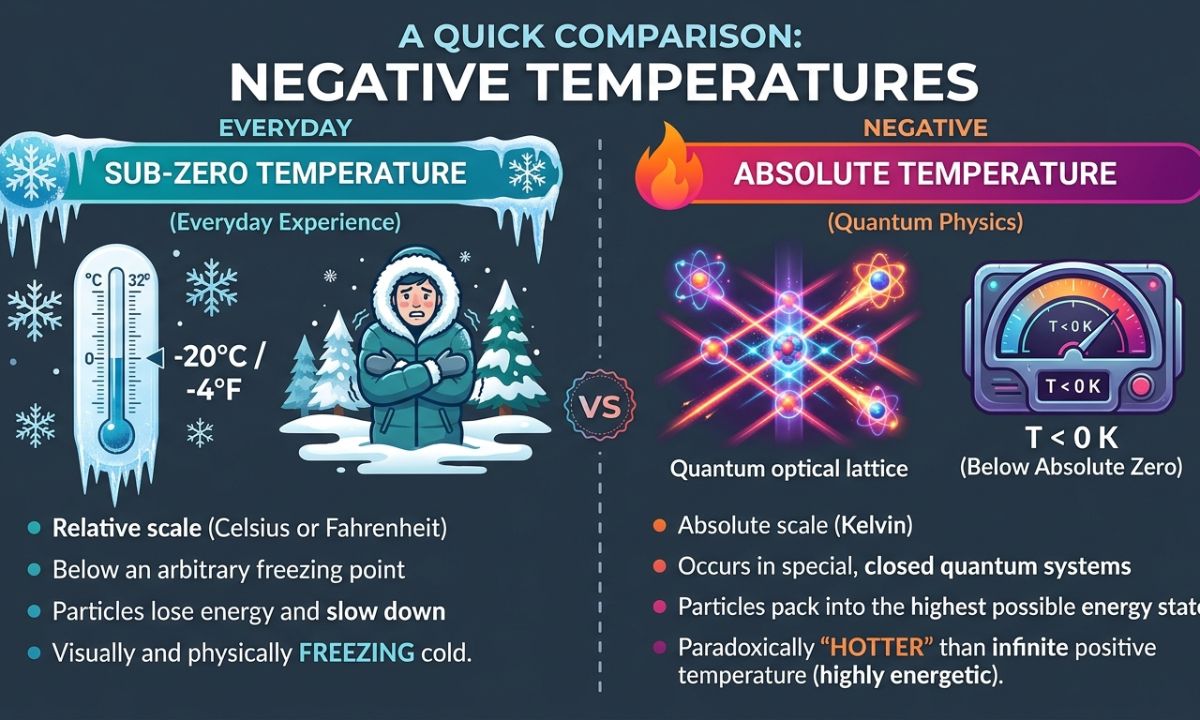
Here’s how the scales drift apart as it gets colder:
| °C | °F | Which Number Looks Lower? |
| −10 | 14 | Celsius |
| −20 | −4 | Celsius |
| −30 | −22 | Celsius |
| −40 | −40 | Equal |
| −50 | −58 | Fahrenheit |
| −60 | −76 | Fahrenheit |
Rule of thumb: above −40, the Fahrenheit number is higher. Below −40, it’s lower. The actual coldness is always the same. Only the label changes.
Places Where −40 Is a Real Thing
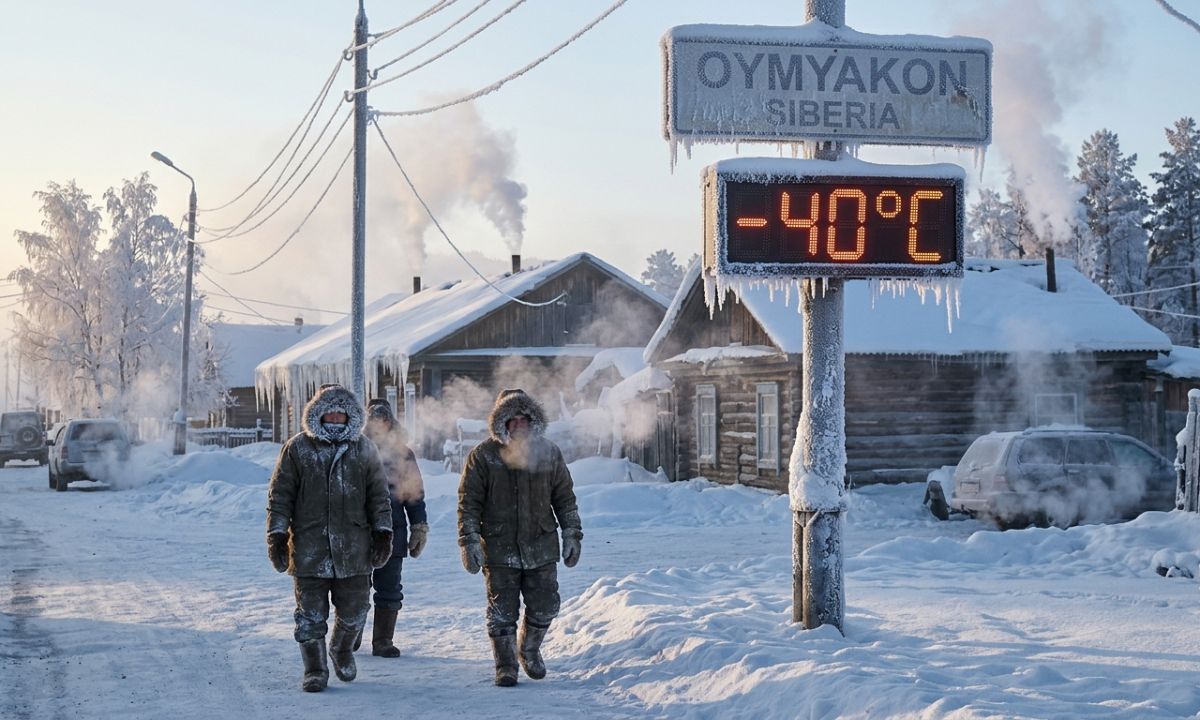
This isn’t just a trivia fact. Some places hit −40 regularly in winter. Others go much lower:
| Place | Record Low | In °F |
| Vostok Station, Antarctica | −89.2°C | −128.6°F |
| Oymyakon, Russia | about −67.7°C | about −89.9°F |
| Snag, Yukon, Canada | −63°C | −81.4°F |
Parts of Siberia, northern Canada, and interior Alaska see −40 in a normal cold snap. People there still go to school and work. They just dress very carefully.
What −40 Feels Like (Honestly)
Brutal, but manageable with the right gear.
Your nostrils stick together when you breathe in. Eyelashes can freeze. Metal feels sharp to touch. Snow squeaks loudly under your boots. Plastic gets brittle, and car batteries struggle.
Skin on your face stings within a minute or two if it’s bare. Wind makes everything worse.
What Happens to the Body at −40
At −40 degrees, your body loses heat fast. Exposed skin can get frostbite in minutes, and wind speeds that up.
| Body Part | Risk at −40 |
| Fingers and toes | Frostbite, numbness |
| Nose and ears | Frostbite quickly |
| Lungs | Cold air irritation, coughing |
| Core | Hypothermia over time |
What helps:
- Layers: base, insulating, windproof outer
- Insulated mittens (warmer than gloves)
- Face covering and a hat
- Dry socks, spare pair on hand
- Short time outside, with someone who knows where you are
Real-Life Situations Where This Matters

The traveler. You’re reading a weather report in Celsius but think in Fahrenheit. Knowing −40 is equal helps you pack correctly.
The student. Your homework asks which is colder. Answer: neither.
The remote worker or driver. Winter in Canada or Alaska? You need to know what the forecast really means for your car and your skin.
The curious reader. It’s a great trivia fact.
| Scenario | What You Should Know |
| Forecast says −40°F | Same as −40°C |
| Forecast says −30°C | Warmer than −40, about −22°F |
| Forecast says −50°F | Colder than −40, about −45.6°C |
| Fridge reads 40°F | About 4.4°C, safe cold storage |
Common Mistakes & Misconceptions
- Thinking Fahrenheit is always the bigger number. Fix: True for most temperatures, but they match at −40.
- Assuming −40°C is colder than −40°F. Fix: They’re equal. Same thing.
- Mixing up 40°C and 40°F. Fix: 40°C is 104°F (hot). 40°F is about 4°C (chilly).
- Adding 32 and forgetting to multiply. Fix: Multiply by 1.8 first, then add 32.
- Ignoring wind chill. Fix: Wind makes it feel colder than the thermometer says.
- Treating −40 as only a number. Fix: It’s dangerous without proper clothing.
Why People Search “Which Is Colder: Minus 40°C or Minus 40°F?”
Most people want a fast answer to a trick question. Some are checking homework. Some saw it in a quiz or video. Others are planning a trip and want to understand a forecast.
The real problem is usually confusion between two scales. People want a clean answer, plus a way to remember it.
Handy shortcuts and habits:
- Remember: −40 is the meeting point.
- Quick estimate: double Celsius and add 30 (rough, for small numbers).
- Check a conversion table before travel.
- Set your phone’s weather app to show both units.
- For cold exposure, check wind chill as well as temperature.
Also Read More : Which Is Colder: Minus 40°C
FAQs
Which is colder: minus 40°C or minus 40°F?
Neither. They’re exactly equal, so −40°C and −40°F describe the same cold.
Is there another temperature where Celsius and Fahrenheit match?
No. −40 is the only point where the two scales give the same number.
How do I convert Celsius to Fahrenheit quickly?
Multiply the Celsius number by 1.8, then add 32. For −40°C, that gives −72 + 32 = −40°F.
How cold is −40 for a human?
Very dangerous without protection. Bare skin can get frostbite in minutes, so layers, mittens, and a face covering matter.
Is −50°F colder than −50°C?
No, it’s the other way around. −50°C equals −58°F, so it’s colder than −50°F, which is about −45.6°C.
Conclusion
Which is colder: minus 40°C or minus 40°F? Neither, because they’re the same temperature. The two scales cross at exactly −40, thanks to the offset of 32 and the 1.8 scaling factor.
Below −40, Fahrenheit shows the lower number. Above it, Celsius does. At −40, your body still needs serious protection from the cold, whichever label you use.