

You’re setting an alarm, planning a shift, or counting down to a medication dose. You need to know: 12 hours from now is what time?
Good news. This is one of the easiest time calculations there is, because a 12-hour jump flips your clock between AM and PM without changing the numbers. This guide gives you the shortcut, the full method, and plenty of examples so you can answer it in about two seconds.
Quick Answer: 12 Hours From Now Is What Time?
Keep the same clock numbers and switch AM to PM, or PM to AM.
That’s the whole trick.
- 3:15 PM now → 3:15 AM in 12 hours
- 9:40 AM now → 9:40 PM in 12 hours
- 12:00 noon now → 12:00 midnight in 12 hours
On a 24-hour clock, it’s just as simple: add 12 hours, and if the result passes 24:00, subtract 24.
One catch: the date changes when you go from PM to AM. If it’s 8:00 PM Monday, 12 hours from now is 8:00 AM Tuesday.
Quick Reference Table: 12 Hours From Now (AM to PM)
If it’s currently morning, here’s what time it will be 12 hours later.
| Current Time (AM) | 12 Hours From Now | Same Day? |
| 12:00 AM (midnight) | 12:00 PM (noon) | Yes |
| 1:00 AM | 1:00 PM | Yes |
| 3:30 AM | 3:30 PM | Yes |
| 5:00 AM | 5:00 PM | Yes |
| 6:45 AM | 6:45 PM | Yes |
| 8:00 AM | 8:00 PM | Yes |
| 9:15 AM | 9:15 PM | Yes |
| 10:30 AM | 10:30 PM | Yes |
| 11:59 AM | 11:59 PM | Yes |
Every morning start lands in the evening of the same day. No date change to worry about.
Quick Reference Table: 12 Hours From Now (PM to AM)
If it’s currently afternoon or evening, you’ll cross midnight.
| Current Time (PM) | 12 Hours From Now | Same Day? |
| 12:00 PM (noon) | 12:00 AM (midnight) | Next day |
| 1:00 PM | 1:00 AM | Next day |
| 3:15 PM | 3:15 AM | Next day |
| 5:30 PM | 5:30 AM | Next day |
| 7:00 PM | 7:00 AM | Next day |
| 8:45 PM | 8:45 AM | Next day |
| 10:00 PM | 10:00 AM | Next day |
| 11:30 PM | 11:30 AM | Next day |
Notice the pattern. PM start times always push you into the next calendar day.
How to Calculate 12 Hours From Now (Step by Step)
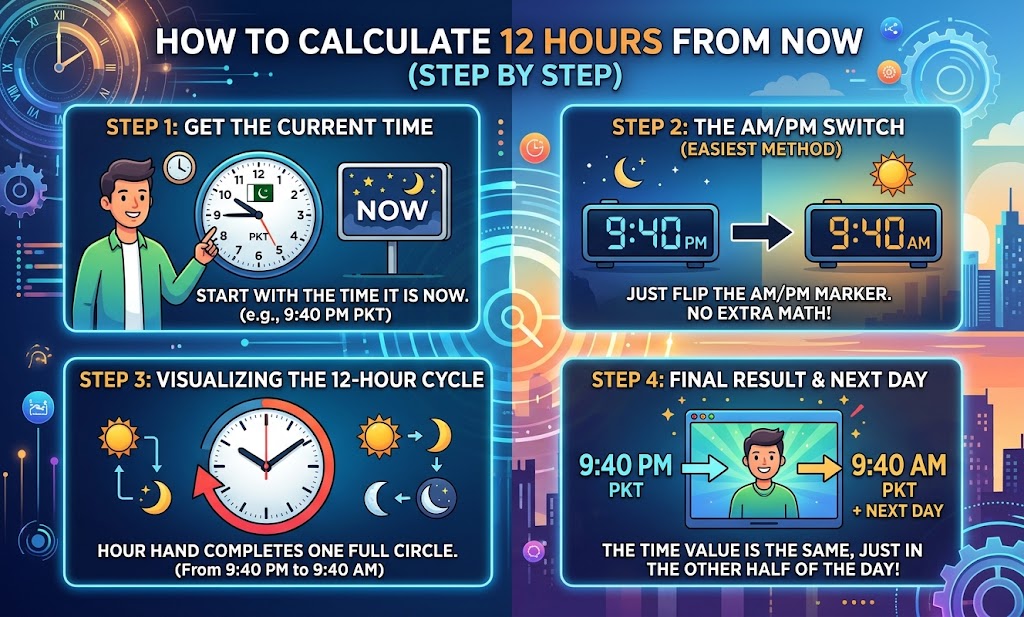
You can do this three ways. Use whichever fits the moment.
Method 1: The Flip Method
This is the fastest option.
- Look at the current time.
- Keep the hour and minutes exactly the same.
- Swap AM for PM, or PM for AM.
- If you swapped PM to AM, move the date forward one day.
Example: It’s 4:20 PM on Friday.
- Keep 4:20
- Flip PM to AM
- Move to the next day
- Answer: 4:20 AM on Saturday
Also Read Time : 12 Hours From Now Is What Time
Method 2: The 24-Hour Clock Method
Military time makes the math mechanical, which is great if you want certainty.
- Convert the current time to 24-hour format.
- Add 12.
- If the result is 24 or higher, subtract 24 and move to the next day.
- Convert back to 12-hour time if needed.
Example: It’s 7:45 PM.
- 7:45 PM = 19:45
- 19:45 + 12 hours = 31:45
- 31:45 − 24 = 07:45 (next day)
- Answer: 7:45 AM tomorrow
Method 3: Count in Two Chunks
Handy when you want to picture it.
- Count the hours from now to the next noon or midnight.
- Subtract that from 12.
- Add the leftover hours after that point.
Example: It’s 9:00 PM.
- 9:00 PM to midnight = 3 hours
- 12 − 3 = 9 hours left
- Midnight + 9 hours = 9:00 AM
All three methods give the same answer. Pick the one that clicks.
The Formula in One Line
Time in 12 hours = (Current hour + 12) mod 24, with minutes unchanged.
In plain English: add 12 to the hour on a 24-hour clock and wrap around at 24.
| Current Time (24-Hour) | Add 12 | Result (24-Hour) | Result (12-Hour) |
| 00:00 | 12:00 | 12:00 | 12:00 PM |
| 06:30 | 18:30 | 18:30 | 6:30 PM |
| 12:00 | 24:00 | 00:00 | 12:00 AM |
| 15:45 | 27:45 | 03:45 | 3:45 AM |
| 18:00 | 30:00 | 06:00 | 6:00 AM |
| 22:15 | 34:15 | 10:15 | 10:15 AM |
What About Noon and Midnight?
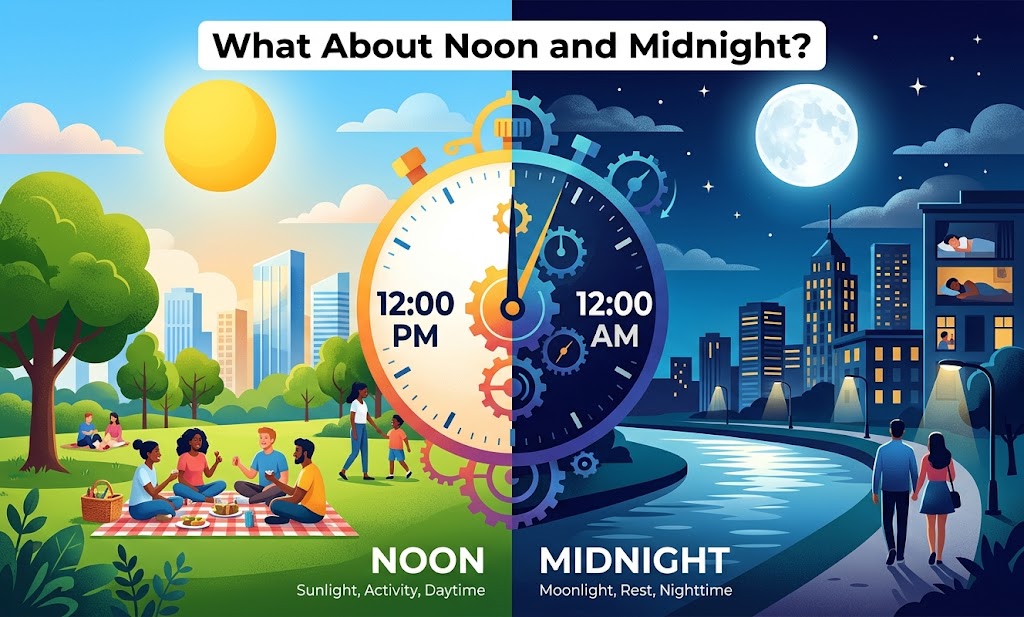
These two cause the most confusion, so let’s slow down.
- 12:00 AM is midnight, the start of the day.
- 12:00 PM is noon, the middle of the day.
Twelve hours after midnight is noon. Twelve hours after noon is midnight. The flip method still works, but people second-guess it because “12 AM” and “12 PM” feel backwards.
| Now | 12 Hours From Now |
| 12:00 AM (midnight) | 12:00 PM (noon) |
| 12:00 PM (noon) | 12:00 AM (midnight, next day) |
| 12:30 AM | 12:30 PM |
| 12:30 PM | 12:30 AM (next day) |
If you want to avoid the headache, say “noon” and “midnight” out loud instead of “12 PM” and “12 AM.” It removes the ambiguity.
Real-World Examples
Here’s where this calculation shows up in daily life.
| Scenario | Start Time | 12 Hours Later |
| Medication every 12 hours | 8:00 AM | 8:00 PM |
| Night shift start to finish | 7:00 PM | 7:00 AM next day |
| Slow cooker on low overnight | 10:00 PM | 10:00 AM next day |
| Fasting window ends | 8:00 PM | 8:00 AM next day |
| Sourdough bulk ferment | 9:30 PM | 9:30 AM next day |
| 12-hour work shift | 6:00 AM | 6:00 PM |
In every case, the minutes stay the same and AM/PM flips.
12 Hours From Now Across Time Zones

If you’re coordinating with someone abroad, add the time zone offset first, then do the 12-hour jump.
Example: It’s 3:00 PM in New York (Eastern). Your colleague in London is 5 hours ahead.
- London time now: 8:00 PM
- 12 hours from now in London: 8:00 AM next day
| Your Time | Their Time (+5 hrs) | Their Time in 12 Hours |
| 9:00 AM | 2:00 PM | 2:00 AM next day |
| 12:00 PM | 5:00 PM | 5:00 AM next day |
| 6:00 PM | 11:00 PM | 11:00 AM next day |
Do the zone conversion first. Mixing up the order is a common way to end up an hour or two off.
Common Mistakes When Finding 12 Hours From Now
Simple math still trips people up. Here’s what to watch for.
Forgetting the Date Changes
Going from PM to AM means you’re in tomorrow. If you’re scheduling something, double-check the day, not just the time.
Messing Up Noon and Midnight
People often assume 12:00 PM is midnight. It’s noon. Mixing them up flips your answer by 12 hours.
Adding 12 to the Wrong Format
Adding 12 to “7 PM” gives you “19,” not “7 PM + 12 = 19 PM.” Convert to 24-hour time first, then add.
Ignoring Daylight Saving Time
On the two days a year when clocks shift, 12 hours of real time may not match 12 hours on the clock. If you cross a clock change, add or subtract one hour from your result.
Forgetting Time Zones
If someone else is involved, the question changes. “12 hours from now” for you may land at a completely different clock time for them.
Why People Search “12 Hours From Now Is What Time”

It looks like an odd question, but the reasons are completely practical.
- Medication schedules. Many prescriptions are taken every 12 hours, so people want the next dose time.
- Shift work. Nurses, security staff, and factory workers often work 12-hour shifts and want to know when they clock out.
- Cooking and fermenting. Slow cooking, marinating, proofing dough, and brining all run in long windows.
- Intermittent fasting. A 12-hour fast is common, and people want to know when it ends.
- Travel planning. Flights and layovers get easier to plan with a quick 12-hour check.
- Quick scheduling. Sometimes you just need a fast answer without opening a calculator.
The goal is nearly always the same: get a reliable time without thinking too hard.
Related Calculations and Topics
Once you’ve got 12 hours down, the rest follows the same logic. People also search for:
- What time will it be in 6 hours
- What time will it be in 24 hours
- 12 hours ago from now
- How many hours until a specific time
- Add hours to a clock time
- Convert 12-hour time to 24-hour time
- What time is it 12 hours ahead in another time zone
Here’s a quick comparison of common time jumps.
| Jump | Effect on Clock | Date Change? |
| +6 hours | Moves a quarter of the day | Sometimes |
| +12 hours | Same numbers, AM/PM flips | Only if PM to AM |
| +18 hours | 6 hours earlier on the clock, flipped | Usually |
| +24 hours | Same time, next day | Always |
And a quick look at 12 hours ago:
| Now | 12 Hours Ago |
| 8:00 AM | 8:00 PM yesterday |
| 2:00 PM | 2:00 AM today |
| 11:00 PM | 11:00 AM today |
The flip method works backward too. Just watch the date.
Quick Tips to Get It Right Every Time
- Flip AM and PM first. Do the obvious part before anything else.
- Check the date. If you went PM to AM, it’s tomorrow.
- Say noon and midnight. It beats saying 12 AM or 12 PM.
- Use 24-hour time for serious stuff. Medication and travel deserve zero ambiguity.
- Set an alarm. For anything important, let your phone do the remembering.
- Account for time zones. Convert to the right zone before you add the 12 hours.
Also Read Time : 12 Hours From Now Is What Time
FAQs
12 hours from now is what time if it’s 3:00 PM?
It will be 3:00 AM the next day. Keep the numbers, flip PM to AM, and move the date forward.
What time is 12 hours from now if it’s 9:30 AM?
9:30 PM the same day. Morning times land in the evening with no date change.
Is 12 hours from midnight noon?
Yes. 12 hours after 12:00 AM is 12:00 PM, which is noon.
How do I calculate 12 hours from now on a 24-hour clock?
Add 12 to the hour. If the total is 24 or more, subtract 24. For example, 20:00 plus 12 hours is 32:00, which becomes 08:00 the next day.
Does daylight saving time change what time it is 12 hours from now?
Yes, but only on the two days when clocks change. If your 12-hour window crosses the change, the clock result shifts by one hour from what you’d normally expect.
Conclusion
When you ask 12 hours from now is what time, the answer is almost always the same clock reading with AM and PM flipped. Morning becomes evening on the same day. Evening becomes morning on the next day. Noon becomes midnight, and midnight becomes noon.
If you want extra certainty, switch to 24-hour time, add 12, and subtract 24 if you pass the limit. Keep an eye on time zones and daylight saving changes, and you’ll never get this one wrong.
1 thought on “12 Hours From Now Is What Time? Easy Ways to Find the Answer”