
Droven.io DevOps Tutorials provide helpful insights into DevOps practices, tools, and modern software development workflows. Whether you are a beginner or an experienced developer, learning about automation, continuous integration, continuous delivery (CI/CD), and cloud technologies can help you improve your technical skills. These tutorials make complex DevOps concepts easier to understand.
With Droven.io DevOps tutorials, readers can explore useful tools, deployment strategies, containerization, and infrastructure management. The guide helps developers understand how DevOps works and how to apply its principles to real-world projects. By learning these techniques, you can improve collaboration, streamline workflows, and build more efficient software systems.
What Is Droven.io and Why It Matters for Developers
Droven.io is an online name that appears in developer-focused content about tech tools, coding workflows, and software productivity. Several sites present it as a reference point for tool recommendations and development insights.
A quick note on trust: public documentation about Droven.io is thin. Treat any claim about specific features or compliance as something to verify directly before you rely on it. The practical value here lies in the DevOps topics it points toward: faster delivery, fewer errors, and smoother teamwork.
Why Developers Choose Droven io Best Tech Tools for Developers
Developers search for this topic because they want one clear starting point. Instead of reading ten separate reviews, they want a shortlist tied to real workflow stages.
Common reasons include:
- A single overview of tools across the full development cycle
- Less time lost comparing similar products
- Practical advice for both beginners and senior engineers
- A focus on efficiency rather than feature lists
Core Categories of Droven io Best Tech Tools for Developers
Most developer stacks fall into six groups. Knowing them helps you spot gaps in your own setup.
- Code editors and IDEs: Visual Studio Code and JetBrains products.
- Version control: Git, GitHub, and GitLab.
- CI/CD and automation: GitHub Actions, GitLab CI, and Jenkins.
- Containers and orchestration: Docker and Kubernetes.
- Infrastructure as Code: Terraform and Ansible.
- Monitoring and observability: Prometheus, Grafana, and Datadog.
Add API tools like Postman and testing tools like Playwright, and you have a complete modern stack.
Read More: growth navigate
Key Features That Drive Developer Efficiency
Good tools share a few traits. Look for these before you commit:
- Integration: The tool connects with your editor, repository, and cloud provider.
- Automation: It removes repetitive manual steps.
- Clear feedback: Errors are easy to read and fix.
- Scalability: It works for one developer and for fifty.
- Active community: Documentation and support are easy to find.
How Droven.io Improves Real Developer Workflow
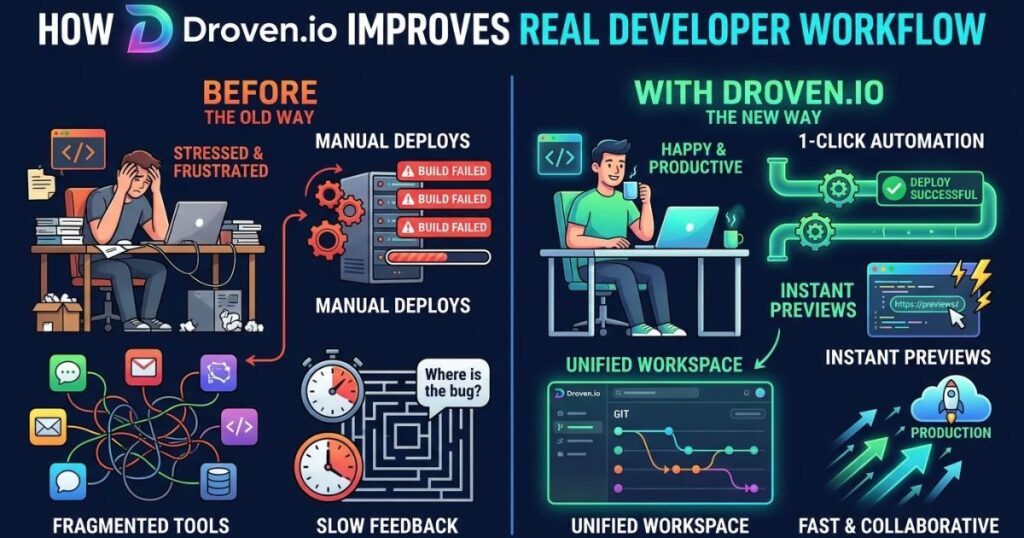
A healthy workflow moves code from idea to production with as little friction as possible. Here is a simple example of how a DevOps pipeline looks in practice.
- A developer pushes code to a Git repository.
- A CI tool runs automated tests on every commit.
- A Docker image is built and stored in a registry.
- The pipeline deploys to a staging environment.
- After approval, the release goes live.
- Monitoring tools watch for errors and slow responses.
When each step is automated, the team spends less time on releases and more time on features. In my experience with small teams, the biggest early win is automating tests. It catches problems while they are still cheap to fix.
Benefits of Using Droven io Best Tech Tools for Developers
- Faster releases: Automation shortens the time between commit and deployment.
- Higher code quality: Automated checks catch bugs early.
- Better collaboration: Shared tools keep everyone on the same page.
- Lower stress: Reliable rollbacks make deployments less scary.
- Clearer decisions: A defined toolset reduces tool fatigue.
Real-World Use Cases Across Industries
DevOps tools are not just for tech startups. Here is where they show up:
- E-commerce: Teams deploy updates during peak sales without downtime.
- Fintech: Automated security scans support strict compliance needs.
- Healthcare: Containerized apps keep patient systems consistent across environments.
- SaaS: Continuous delivery lets teams ship small updates daily.
- Gaming: Scalable infrastructure handles sudden player spikes.
Traditional vs Modern Development Workflow
| Area | Traditional Workflow | Modern DevOps Workflow |
| Releases | Monthly or quarterly | Daily or weekly |
| Testing | Manual, late in the cycle | Automated, on every commit |
| Infrastructure | Set up by hand | Defined as code |
| Team structure | Dev and Ops separated | Shared ownership |
| Failure response | Slow, reactive | Fast, with monitoring and rollback |
The shift is cultural as much as technical. Teams that share responsibility for code in production tend to build more reliable systems.
How to Start Using Droven.io Insights Effectively
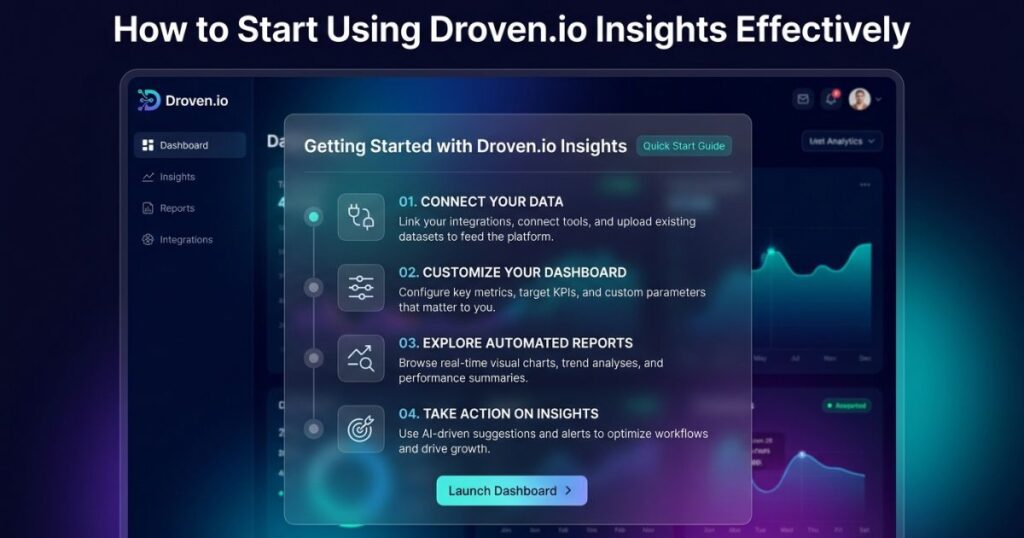
You do not need to adopt everything at once. Follow this order:
- Audit your current process. List every manual step from commit to release.
- Pick one pain point. Slow testing and messy deployments are common starters.
- Choose one tool. For example, set up GitHub Actions to run tests.
- Measure the result. Track build time and failed deployments.
- Expand gradually. Add containers, then Infrastructure as Code, then monitoring.
Small steps beat big rewrites.
Role of AI in Developer Productivity
AI coding assistants like GitHub Copilot now suggest code, write tests, and explain unfamiliar functions. They reduce boilerplate work and help developers stay focused.
AI also supports DevOps directly:
- Log analysis: Spotting unusual patterns faster than humans can.
- Test generation: Drafting unit tests from existing code.
- Incident response: Summarizing alerts and suggesting likely causes.
A word of caution: always review AI-generated code. It can contain bugs or security flaws. Treat it like a fast junior teammate whose work still needs a check.
Why Automation Is Essential in Modern Development
Manual processes break under pressure. People forget steps, and mistakes slip through. Automation fixes this by making every release follow the same path.
Key areas to automate:
- Testing and code linting
- Builds and packaging
- Deployments and rollbacks
- Security scanning
- Environment setup
The goal is not to remove people. It is to free them for work that needs human judgment.
Key Technologies Explained Simply
What is CI/CD? Continuous Integration merges and tests code often. Continuous Delivery prepares it for release automatically.
What is containerization? A container packages an app with everything it needs to run. Docker is the most common tool, and it ends the classic “it works on my machine” problem.
What is Kubernetes? It manages many containers at once, handling scaling and restarts automatically.
What is Infrastructure as Code? You describe servers and networks in files, using tools like Terraform. Changes become trackable and repeatable.
What is observability? It is the ability to understand system health through logs, metrics, and traces.
Read More: team aelftech.com
Challenges Solved by Modern Developer Tools
- Environment mismatch: Containers keep development and production consistent.
- Slow feedback: CI pipelines report problems in minutes.
- Configuration drift: Infrastructure as Code keeps servers identical.
- Knowledge silos: Shared repositories and documentation spread understanding.
- Deployment fear: Automated rollbacks make mistakes recoverable.
Security and Reliability Considerations

Speed means little if your system is unsafe. This is where DevSecOps comes in: building security into every stage instead of adding it at the end.
Practical steps to take:
- Scan dependencies for known vulnerabilities on every build.
- Never store secrets in code. Use a secrets manager.
- Apply least privilege to every account and pipeline.
- Sign and verify container images.
- Back up and test recovery. A backup you have never restored is only a hope.
- Keep audit logs for key actions.
For reliability, set clear targets such as uptime goals, and review incidents without blaming individuals. Learning from failure makes systems stronger.
Best Practices for Maximum Productivity
- Keep commits small and frequent.
- Write tests before you need them.
- Document your pipeline so new teammates can follow it.
- Use feature flags to release code safely.
- Review your toolset every few months and remove what you do not use.
- Track metrics like deployment frequency, lead time, and failure rate.
- Choose tools that fit your team size, not the most popular option.
Future Trends in Developer Tools
Several shifts are already underway:
- Platform engineering: Internal platforms give developers self-service environments.
- AI-driven operations: Automated detection and fixing of common issues.
- Policy as code: Compliance rules checked automatically.
- Cost awareness (FinOps): Teams watch cloud spend as closely as performance.
- Edge and serverless deployment: Code runs closer to users with less infrastructure management.
Developers who understand both the tools and the principles behind them will adapt fastest.
FAQ’s
What is Droven.io DevOps tutorials?
Droven.io DevOps tutorials are online lessons that teach DevOps skills such as CI/CD, cloud, containers, and automation through step-by-step guides.
How do I start learning DevOps with Droven.io?
Start with the beginner tutorials on Linux, Git, and CI/CD basics, then move on to Docker, Kubernetes, and cloud platforms.
Are Droven.io DevOps tutorials good for beginners?
Yes. The tutorials explain DevOps concepts in simple steps, so beginners can follow along without prior experience.
Are Droven.io DevOps tutorials free?
Droven.io offers free tutorials and guides. Check the website for any paid courses or premium content.
What topics do Droven.io DevOps tutorials cover?
They cover CI/CD pipelines, Docker, Kubernetes, Terraform, Ansible, Git, Jenkins, and cloud services like AWS.
Final Thoughts
Great DevOps is not about owning the longest tool list. It is about building a smooth path from code to production, with automation, security, and monitoring at each step.
Start small. Automate your tests, containerize one app, and measure what changes. Then keep improving. Treat any source, including Droven.io, as a starting point, and confirm tool details through official documentation before you commit.
2 thoughts on “Droven.io DevOps Tutorials: Tools, Tips & Complete Guide”