

You glance at the clock and need to know what was 12 hours ago from now. Maybe you’re checking when a delivery left, when a fever started, when a server log went quiet, or when you last took a medicine.
The good news: this is one of the easiest time calculations there is. Twelve hours is exactly half a day, so you only flip AM to PM (or PM to AM) and keep the same clock numbers. The only thing to watch is whether the date changes.This guide gives you the instant answer, then the method, so you can work it out in your head for any time, any day.
Quick Answer: What Was 12 Hours Ago From Now?
Take the current time, flip AM to PM (or PM to AM), and keep the minutes the same. If the time you’re starting from is in the afternoon or evening, the date stays the same. If it’s in the morning, the date moves back one day.
Example based on right now: it is Tuesday, November 10, 2026, at 3:11 PM. Twelve hours ago was Tuesday, November 10, 2026, at 3:11 AM. Same date, because 3:11 PM is after noon.
| Current time | 12 hours ago | Does the date change? |
|---|---|---|
| 3:11 PM (Tuesday) | 3:11 AM (Tuesday) | No |
| 9:00 AM (Tuesday) | 9:00 PM (Monday) | Yes, back one day |
| 12:00 PM (noon) | 12:00 AM (midnight, same day) | No |
| 12:00 AM (midnight) | 12:00 PM (noon, previous day) | Yes, back one day |
That table covers 90% of what people need. The rest of this article covers the other 10%.
Why Does the 12-Hour Rule Work So Neatly?

A day has 24 hours. Twelve is exactly half. On a 12-hour clock (the kind with AM and PM), going back 12 hours puts you at the same clock position, just on the opposite half of the day.
So there’s no real subtraction involved. 4:30 PM becomes 4:30 AM. 11:45 AM becomes 11:45 PM. You change the label and, sometimes, the date.
Useful numbers to remember:
- 12 hours = 720 minutes
- 12 hours = 43,200 seconds
- 12 hours = 0.5 days
How to Calculate What Was 12 Hours Ago From Now (Step by Step)
There are two methods, depending on which clock you read.
Method 1: Using a 12-Hour Clock (AM/PM)
- Note the current time and whether it’s AM or PM.
- Keep the hour and minutes exactly as they are.
- Switch AM to PM, or PM to AM.
- Check the date. If you started in the AM, 12 hours ago is the previous day. If you started in the PM, it’s the same day.
Example: it’s 7:25 AM on Wednesday.
- Keep 7:25.
- Flip AM to PM, giving 7:25 PM.
- You started in the AM, so go back a day: Tuesday at 7:25 PM.
Method 2: Using a 24-Hour Clock
- Subtract 12 from the current hour.
- If the result is zero or positive, you’re on the same day.
- If the result is negative, add 24 and move back one day.
Example A: it’s 17:40. 17 − 12 = 5, so 12 hours ago was 05:40 the same day.
Example B: it’s 06:15. 6 − 12 = −6. Add 24 and you get 18, so 12 hours ago was 18:15 yesterday.
Quick Formula Summary
| Clock type | Formula | Date rule |
|---|---|---|
| 12-hour | Flip AM/PM, keep the numbers | AM start = previous day; PM start = same day |
| 24-hour | Hour − 12 | If negative, add 24 and go back one day |
12 Hours Ago Chart: Common Times Converted
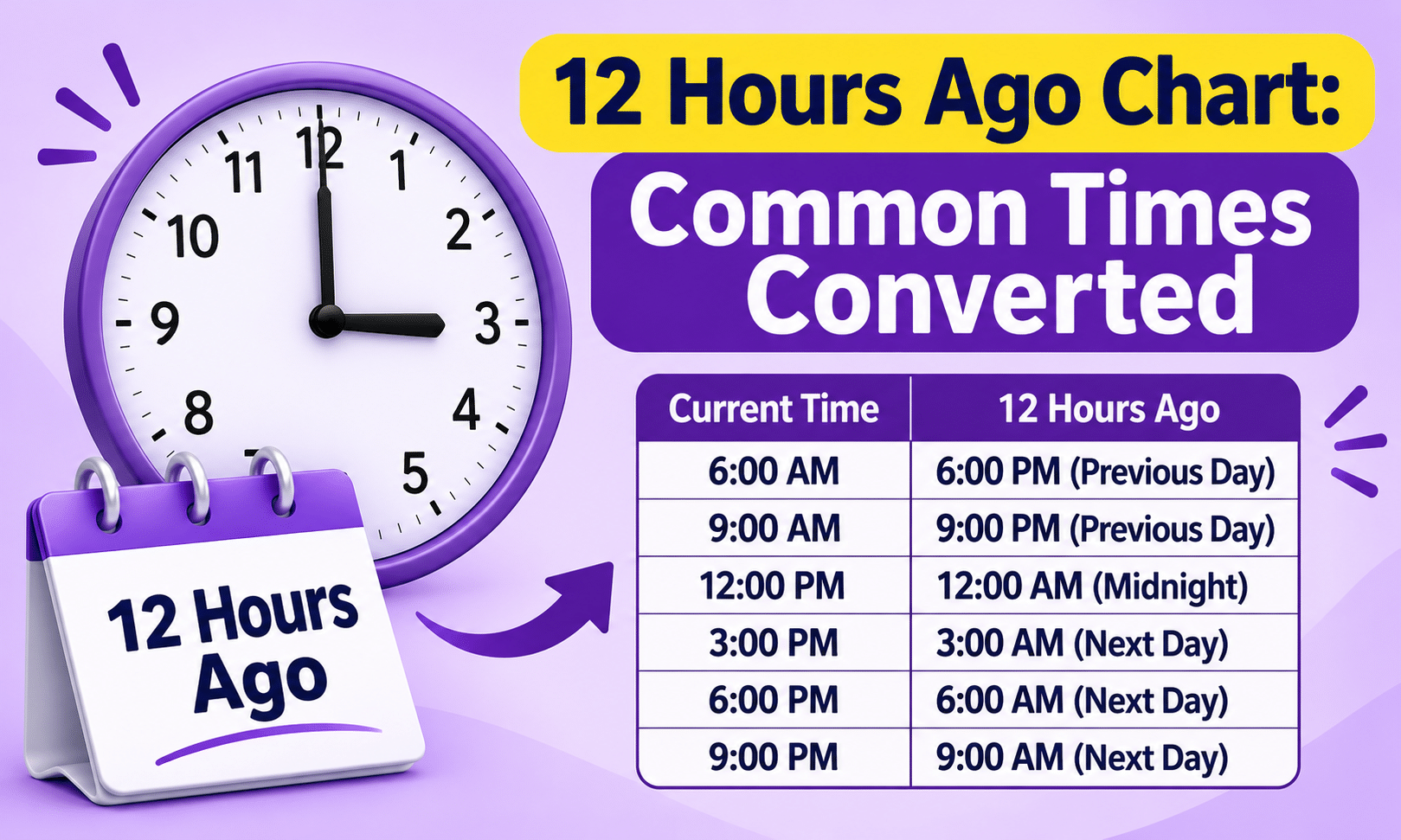
Here’s a reference table you can bookmark. All examples assume the starting date is a Tuesday, so you can see exactly where the day flips.
| Now (12-hour) | Now (24-hour) | 12 hours ago (12-hour) | 12 hours ago (24-hour) | Day |
|---|---|---|---|---|
| 12:00 AM | 00:00 | 12:00 PM | 12:00 | Monday |
| 2:30 AM | 02:30 | 2:30 PM | 14:30 | Monday |
| 6:00 AM | 06:00 | 6:00 PM | 18:00 | Monday |
| 9:45 AM | 09:45 | 9:45 PM | 21:45 | Monday |
| 12:00 PM | 12:00 | 12:00 AM | 00:00 | Tuesday |
| 1:15 PM | 13:15 | 1:15 AM | 01:15 | Tuesday |
| 3:11 PM | 15:11 | 3:11 AM | 03:11 | Tuesday |
| 6:50 PM | 18:50 | 6:50 AM | 06:50 | Tuesday |
| 11:59 PM | 23:59 | 11:59 AM | 11:59 | Tuesday |
Notice the pattern: every morning start lands on the previous evening, and every afternoon or evening start lands on that same morning.
Real-World Scenarios Where This Calculation Matters

People don’t search for this out of curiosity alone. Here are the situations that come up most often.
Medication and Health Tracking
Many prescriptions are taken every 12 hours. If you took a dose at 8:00 AM and it’s now 8:00 PM, exactly 12 hours have passed. Always follow your doctor or the label for dosing, but knowing the time gap helps you stay on schedule.
Shift Work and Sleep Logs
Night-shift workers and new parents constantly count back to figure out how long they’ve been awake. If you woke at 6:00 AM and it’s 6:00 PM, you’ve been up for 12 hours.
Server Logs and Troubleshooting
Developers and IT staff often check the last 12 hours of logs. Knowing the exact starting point, and whether it falls on yesterday, keeps log filters accurate.
Package and Order Tracking
“Shipped 12 hours ago” is a common status. Counting back tells you whether it left this morning or last night.
Social Media and Content Scheduling
Posts show timestamps like “12h.” If you’re measuring when a post went live, working backward gives you the real posting time.
What Was 12 Hours Ago From Now in Different Time Zones?
Your answer changes if you’re comparing across time zones, but the 12-hour gap itself never changes. What changes is the clock reading in each place.
Using our example moment (3:11 PM in Pakistan Standard Time, UTC+5), here’s what the same instant looks like elsewhere, along with the time 12 hours earlier in each place:
| Location | UTC offset | Time now | 12 hours ago |
|---|---|---|---|
| Karachi / Islamabad | UTC+5 | 3:11 PM Tue | 3:11 AM Tue |
| UTC (London in winter) | UTC+0 | 10:11 AM Tue | 10:11 PM Mon |
| Dubai | UTC+4 | 2:11 PM Tue | 2:11 AM Tue |
| New York (EST) | UTC−5 | 5:11 AM Tue | 5:11 PM Mon |
| Tokyo | UTC+9 | 7:11 PM Tue | 7:11 AM Tue |
Same moment, four different “yesterday or today” answers. If you’re coordinating with someone abroad, always confirm which time zone’s clock you’re reading.
Common Mistakes and Misconceptions
Even simple time math goes wrong in predictable ways. Watch out for these.
1. Forgetting the date changes in the morning. This is the big one. At 8:00 AM, people say “12 hours ago was 8:00 PM” and forget it was yesterday. Always check the date when you start in the AM.
2. Mixing up noon and midnight. 12:00 PM is noon. 12:00 AM is midnight. Twelve hours before noon is midnight, and twelve hours before midnight is noon of the previous day. Plenty of people flip these.
3. Subtracting 12 on a 12-hour clock. If it’s 3:00 PM, subtracting 12 gives −9, which makes no sense on a 12-hour clock. Just flip the label instead.
4. Ignoring time zones. “12 hours ago” for you is not the same wall-clock time for a colleague in another country. Convert to one shared zone first, such as UTC.
5. Forgetting daylight saving time. On the day clocks change, 12 hours of real elapsed time may not match a 12-hour difference on the wall clock. If the clocks shifted overnight, you may be off by an hour. Digital tools handle this automatically, but mental math won’t.
6. Assuming “12 hours” means “half a day of daylight.” Twelve hours is a fixed duration. Daylight hours vary by season and location, so don’t confuse the two.
Why Do People Search “What Was 12 Hours Ago From Now”?
The search is almost always practical, and usually urgent. Here’s what drives it:
- Quick verification. People want a fast, reliable answer without opening a calculator.
- Tired brains. Nobody does clean math at 3 AM or after a double shift.
- Cross-day confusion. The date flip trips people up, so they look for confirmation.
- Record keeping. Logs, reports, and forms often ask for events “within the last 12 hours.”
- Health and safety. Medication timing, fever tracking, and baby feeding schedules all rely on accurate time gaps.
If you’re one of those people, bookmark the chart above. It answers the question in about two seconds.
See also:17 Hours Ago From Now
Related Time Calculations You Might Need

Once you know the 12-hour trick, other offsets get easy too.
| Question | Method | Example from 3:11 PM Tuesday |
|---|---|---|
| 12 hours from now | Flip AM/PM; PM start = next day | 3:11 AM Wednesday |
| 24 hours ago | Same time, one day back | 3:11 PM Monday |
| 6 hours ago | Subtract 6 | 9:11 AM Tuesday |
| 8 hours ago | Subtract 8 | 7:11 AM Tuesday |
| 18 hours ago | Subtract 18 (or 24 − 6) | 9:11 PM Monday |
| 36 hours ago | 24 + 12, back a day and flip | 3:11 AM Monday |
| 48 hours ago | Two days back, same time | 3:11 PM Sunday |
A shortcut for any “hours ago” question: break it into 12-hour or 24-hour chunks first, then handle the leftover. For 18 hours, go back 12 (flip AM/PM) and then 6 more.
Handy Tips for Always Getting It Right
- Use the 24-hour clock for math. It removes the AM/PM guesswork entirely.
- Write the date next to the time. “3:11 AM” means little. “3:11 AM Tuesday” is precise.
- Check midnight carefully. Most errors happen near 12:00 AM and 12:00 PM.
- Let your phone double-check. Set a timer or use a world clock when stakes are high, like medication or legal deadlines.
- Standardize on UTC for teams. If you work across countries, log everything in UTC and convert only for display.
Frequently Asked Questions
What was 12 hours ago from now if it’s currently 10:00 PM?
It was 10:00 AM the same day. Since 10:00 PM is in the evening, the date doesn’t change. You only flip PM to AM.
What was 12 hours ago from now if it’s currently 5:00 AM?
It was 5:00 PM the previous day. Starting in the morning means going back into yesterday evening.
How many minutes and seconds are in 12 hours?
There are 720 minutes and 43,200 seconds in 12 hours. That’s 12 × 60 for minutes and 720 × 60 for seconds.
Is 12 hours ago the same as yesterday at this time?
No. “Yesterday at this time” is 24 hours ago. Twelve hours ago is half that, so it lands either earlier today or last night, depending on the current time.
Does daylight saving time change what 12 hours ago was?
Sometimes. On a day when clocks spring forward or fall back, 12 hours of real time can appear as 11 or 13 hours on the wall clock. On normal days, the 12-hour flip works perfectly.
Conclusion
So, what was 12 hours ago from now? Flip AM to PM (or the reverse), keep the minutes, and check whether the date moved back a day. Right now, at 3:11 PM on Tuesday, November 10, 2026, the answer is 3:11 AM the same day.
The method works for any time: AM starts land on yesterday evening, PM starts land on this morning. Remember the 24-hour version (subtract 12, add 24 if negative), watch for time zones and daylight saving changes, and you’ll never second-guess it again.
2 thoughts on “What Was 12 Hours Ago From Now? Quick Answer, Formula and Examples”