
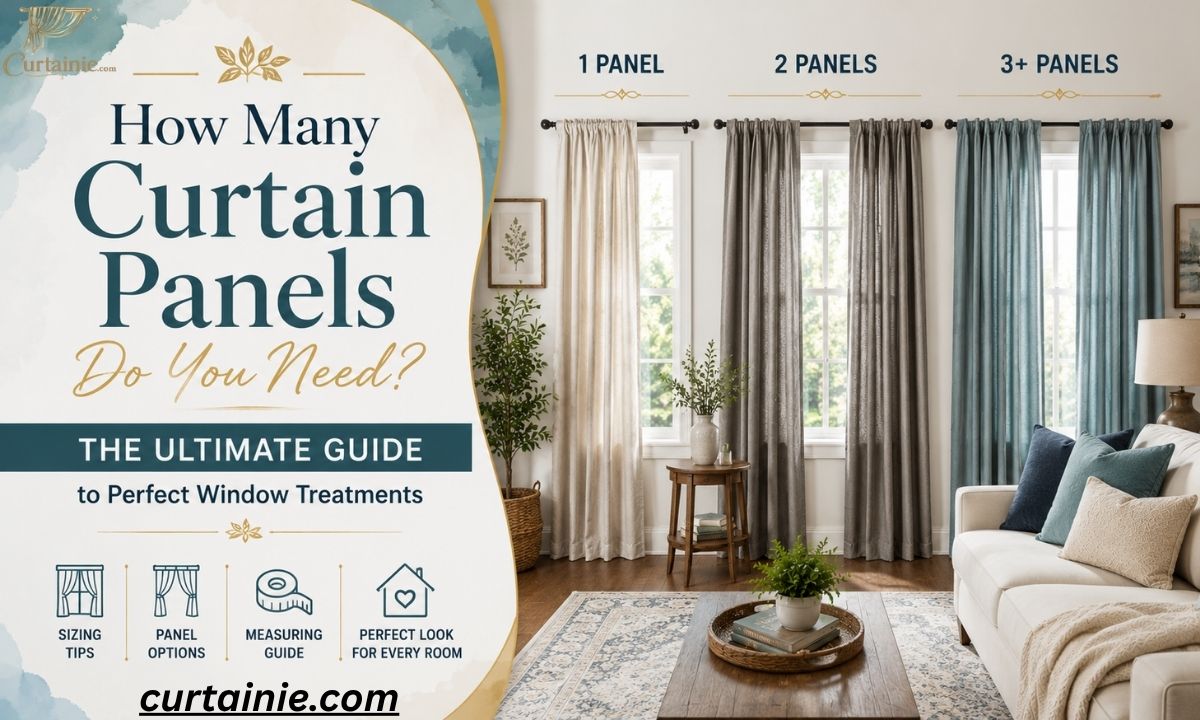
Have you ever bought beautiful curtains, hung them up, and felt like something was just… off? Maybe they looked flat, skimpy, like a bedsheet stretched tightly across your window, or perhaps they were so bunched up you couldn’t even see the pattern. If you are nodding your head right now, you are not alone.
One of the most common dilemmas homeowners and renters face when decorating their spaces is figuring out exactly how many curtain panels do you need. It sounds like a simple math problem, but window treatments are a crucial element of interior design. They control light, provide privacy, and add texture, color, and warmth to a room. Getting the number of panels right is the secret between a window that looks like an afterthought and one that looks like it was styled by a high-end interior designer.
In this comprehensive guide, we will break down the exact formulas, styling tips, and industry secrets you need to figure out how many curtain panels are perfect for your specific windows. Grab your tape measure, and let’s dive in!
Why Getting the Number of Panels Right Matters
Before we get into the math, let’s talk about why this matters. In the interior design world, there is a term called “fullness.” Fullness refers to how gathered or wavy the curtains look when they are closed.
If you use too few panels, your curtains will look like a flat piece of fabric when pulled shut. This is often referred to as a “skimpy” look, and it can instantly make a room feel cheap. On the other hand, if you use too many panels, the fabric will bunch up awkwardly, making it difficult to open and close the curtains, and the window will feel visually heavy and overwhelming.
When you ask, “how many curtain panels do you need,” what you are really asking is, “how do I achieve the perfect fullness for my room?” The right fullness gives your curtains that lush, custom, expensive look—even if you bought them off-the-shelf at a big-box store.

The Golden Rule of Curtains: Understanding “Fullness”
To calculate how many panels you need, you first have to decide how full you want your curtains to look. There are three standard levels of fullness in window treatments:
1. Standard Fullness (1.5x to 2x)
This is the most common look for everyday curtains. To achieve this, the total width of your curtain panels combined should be 1.5 to 2 times the width of your window rod. This gives a nice, tailored look that isn’t too heavy.
- Best for: Casual living rooms, bedrooms, and heavier fabrics like velvet or blackout materials.
2. Deluxe / Rich Fullness (2.5x)
If you want your windows to look professionally styled, aim for 2.5 times the width of your rod. When closed, these curtains still have deep, beautiful folds.
- Best for: Formal dining rooms, master bedrooms, and medium-weight fabrics like cotton or linen blends.
3. Maximum / Sheer Fullness (3x)
Because sheer curtains are so lightweight and translucent, they require a lot more fabric to look substantial. For sheer fabrics, you want the total width of the panels to be 3 times the width of your rod.
- Best for: Sheer curtains, light voiles, and romantic, breezy aesthetics.
Step-by-Step Guide: How to Measure Your Window
You cannot figure out how many curtain panels you need without taking accurate measurements. Here is how to do it the right way, using standard USA inches.
Step 1: Install Your Curtain Rod First
A massive rookie mistake is measuring the window frame itself. Never measure just the window frame. Your curtain rod should extend past the window frame on both sides to make the window look larger and allow maximum light in when the curtains are open.
- Pro Tip: Extend your rod 4 to 8 inches beyond the window frame on each side.
Step 2: Measure the Rod Width
Measure the width of your curtain rod from one end to the other, excluding the decorative finials (the knobs on the ends). Let’s say your curtain rod measures 60 inches wide. This is your magic number.
Step 3: Determine Your Desired Fullness
Decide on the look you want based on the fabric you are buying. For this example, let’s say we want a standard, rich look with medium-weight cotton curtains. We will choose a 2x fullness multiplier.
The Magic Formula: Calculating How Many Panels You Need
Now that you have your rod width and your fullness multiplier, it’s time for some simple math.
The Formula: (Rod Width × Fullness Multiplier) ÷ Width of One Curtain Panel = Number of Panels Needed
Let’s walk through a real-world example. In the USA, standard off-the-shelf curtain panels are usually about 50 inches wide.
- Your Rod Width: 60 inches
- Your Multiplier: 2x
- Total Fabric Width Needed: 60 inches × 2 = 120 inches
- Panel Width: 50 inches
- Calculate: 120 inches ÷ 50 inches = 2.4 panels
What to Do with Fractions?
You obviously cannot buy 0.4 of a curtain panel. When your calculation results in a decimal, always round up to the nearest whole number.
In this case, rounding up gives you 3 panels. However, unless you are sweeping all your curtains to one side (like on a sliding glass door), you generally want an even number of panels so you can split them evenly on the left and right. Therefore, you would round up to 4 panels (two on the left, two on the right) for a lush, luxurious look, or round down to 2 panels if you prefer a slightly less full, more casual appearance.
For a 60-inch rod, 2 panels of 50 inches (100 inches total) will give you a 1.6x fullness, which is perfectly acceptable for standard rooms!
How Window Type Affects Your Panel Count
Not all windows are created equal. The type of window you are dressing plays a massive role in answering how many curtain panels do you need.
1. The Standard Single Window (approx. 24″ – 36″ wide)
For small, single windows, standard off-the-shelf curtains make life easy.
- Recommendation: 2 panels (one for each side). This will give you plenty of fullness without overwhelming the small space.
2. Double Windows / Standard Living Room Windows (approx. 60″ – 72″ wide)
This is where people start making mistakes by only buying two panels. If you put two 50-inch panels on a 72-inch window, they will look incredibly flat when closed.
- Recommendation: 4 panels (two sewn or hung together on the left, two on the right).
3. Sliding Glass Doors & French Doors
Sliding doors are incredibly wide, often 72 to 80 inches or more. Since you usually pull the curtain entirely to one side to use the door, you need a massive amount of fabric.
- Recommendation: You need total fabric width of at least 150 to 160 inches. You can achieve this by buying one extra-wide custom patio panel, or by hanging 3 to 4 standard 50-inch panels together on the same side.
4. Bay Windows
Bay windows are tricky because they usually feature a large central window and two smaller side windows.
- Recommendation: Treat each section as its own window. Use 2 panels for the large center window, and 1 to 2 panels for each of the side windows. This means a standard bay window setup usually requires between 4 to 6 panels in total.
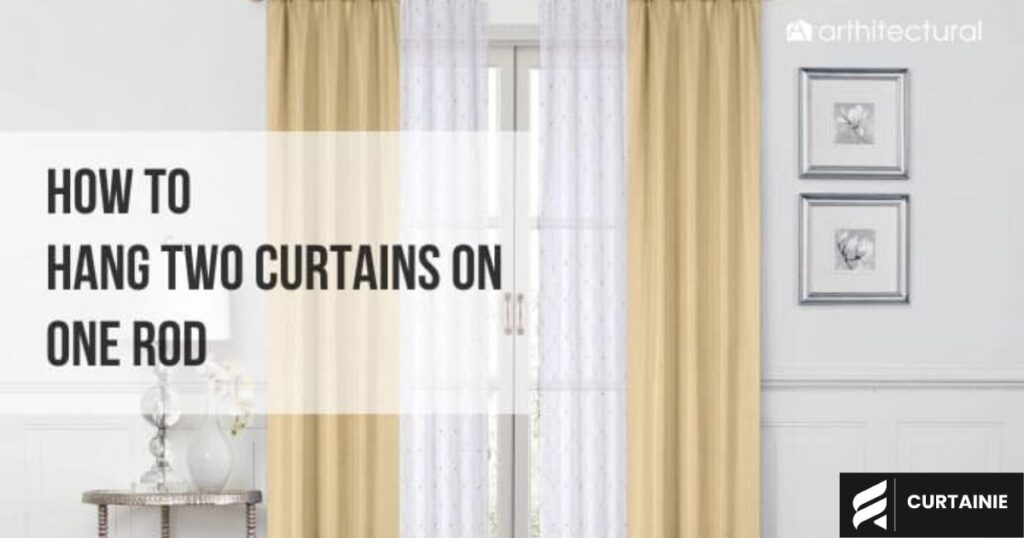
Curtain Heading Styles: Another Crucial Factor
The top of the curtain—how it attaches to the rod—is called the “heading.” The heading dictates how the fabric falls and folds, which directly impacts how many curtain panels you need.
Grommet Curtains
Grommet curtains have metal rings punched into the fabric. Because the rod weaves in and out of the rings, the fabric naturally creates deep, wide folds. Grommet curtains take up more horizontal space on the rod.
- Fullness required: 1.5x to 2x. You rarely need more than this, or the grommets will awkwardly bunch up.
Pinch Pleat Curtains
Pinch pleat curtains have the folds permanently sewn into the top. Because the fullness is already “built-in,” you do not need to do the multiplier math! A 50-inch wide pinch pleat curtain will cover exactly 50 inches of rod.
- Fullness required: 1x (Just match the total width of the pleated panels to the width of your rod).
Rod Pocket & Back Tab Curtains
These styles feature fabric bunched directly onto the rod or suspended by hidden loops. They lie relatively flat if not gathered properly.
- Fullness required: 2x to 2.5x. You need extra fabric here to force the material into beautiful, gathered waves.
Room-by-Room Guide: Tailoring Your Panel Count
The function of the room should dictate your curtain styling. Here is a quick cheat sheet for the main rooms in your American home.
The Living Room
The living room is a showcase space. You want this room to look inviting and expensive.
- Strategy: Aim for 2.5x fullness. Even if you never close the curtains and they strictly serve as decorative side panels (stationary panels), double them up. Using two panels on each side (4 total) makes the window look grand and majestic.
The Bedroom
In the bedroom, privacy and light control are paramount. Most people use blackout curtains here. Because blackout fabrics are thick, stiff, and heavy, too much fullness can make them impossible to open.
- Strategy: Aim for 1.5x to 2x fullness. Two standard 50-inch panels are usually perfect for a standard bedroom window.
The Dining Room
Dining rooms demand drama and elegance. This is the perfect place to experiment with sheer panels layered underneath heavier drapes.
- Strategy: Layering! Use 2 to 4 sheer panels (3x fullness) close to the window, and 2 heavier velvet or silk panels (2x fullness) on a double rod in front of them.

Common Mistakes to Avoid When Buying Curtains
To ensure you never waste money on the wrong window treatments again, avoid these common pitfalls:
- Skimping on Panels to Save Money: Buying only two panels for a massive window to save a few dollars will ruin the aesthetic of the entire room. If you are on a strict budget, buy cheaper fabric (like cotton instead of linen) but buy the correct number of panels. Volume looks more expensive than the fabric itself.
- Ignoring the “Stackback”: Stackback is the space the curtains take up on the wall when they are completely open. If your window is 60 inches wide and you want the curtains to clear the glass when open, your rod needs to be wider than 60 inches, meaning you need more panels to cover the wider rod.
- Buying the Wrong Length: This guide is about width, but length matters! In the USA, standard lengths are 84″, 96″, and 108″. Always hang your rod high (close to the ceiling) and let the curtains lightly touch the floor. “High and wide” is the designer mantra.
Read More ; how many curtain panels do you need
Frequently Asked Questions (FAQs)
1. Do I need 2 or 4 curtain panels for a standard window? Typically, two standard panels are perfectly sufficient for a regular-sized window to achieve a beautiful, gathered look.
2. How wide should curtain panels be compared to the window? The total combined width of your curtain panels should be roughly two times the width of your curtain rod.
3. Can I use an odd number of curtain panels? Yes, an odd number works perfectly for sliding glass doors or wide windows where you draw all the fabric to one single side.
4. Do sheer curtains need more fullness than blackout curtains? Yes, because they are thin and translucent, sheer curtains look best with 3x fullness, whereas blackout curtains only need 1.5x to 2x.
5. How many panels do I need for a sliding glass door? Most standard sliding glass doors require at least four standard 50-inch panels to ensure they look full when pulled closed.
Conclusion
So, exactly how many curtain panels do you need? The answer lies in the width of your rod, the style of your curtains, and the look you want to achieve. By remembering the simple rule of 2x fullness for standard curtains, 3x for sheers, and 1x for pleated drapes, you can confidently shop for window treatments.
Stop settling for flat, uninspiring windows. Take out your tape measure, do the quick math, and give your home the beautiful, lush window treatments it deserves!