
Having a home with 10-foot ceilings is a luxury. High ceilings instantly make a room feel grand, spacious, and airy. However, when it comes to interior design, decorating a room with extra vertical space can present a unique set of challenges—especially when it is time to choose and install window treatments.
Curtains are often referred to as the “eyebrows” of a room. They frame the natural light, add texture, and set the overall mood. If you hang them correctly, they will draw the eye upward and accentuate your beautiful architecture. If you hang them incorrectly, you can visually shrink the room, making the windows look awkwardly small and the ceiling lower than it actually is.
If you are wondering exactly how high to hang curtains on a 10-foot ceiling, you are in the right place. In this comprehensive, step-by-step guide, we will break down the professional rules of curtain placement, the exact measurements you need, and the standard sizes available in the US market to help you achieve a flawless, designer-approved look.
Why Curtain Height Matters So Much
Before diving into the exact measurements, it is essential to understand the “why” behind the rules. Interior designers rely heavily on optical illusions. You can completely change the perceived size and shape of a room simply by manipulating where you draw the viewer’s eye.
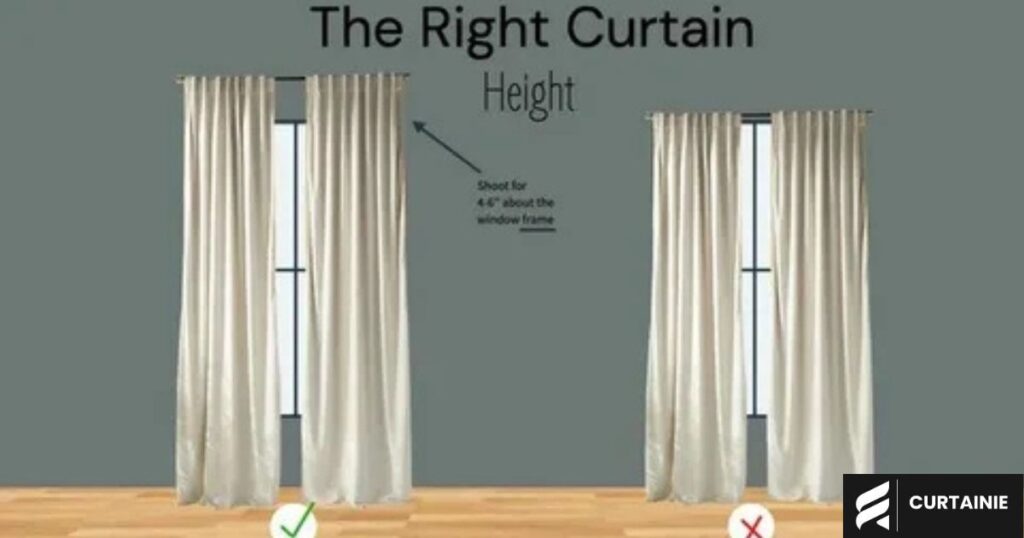
When you have 10-foot (120-inch) ceilings, there is usually a significant amount of blank wall space between the top of your window frame and the ceiling line. If you install your curtain rod directly on the window trim—a very common DIY mistake—you create a harsh horizontal line that cuts the wall in half. This highlights the awkward blank space above the window and makes the room feel disjointed.
By mounting the curtain rod higher up on the wall, you create a continuous, sweeping vertical line of fabric. This draws the eye straight up to the ceiling, emphasizing the height of the room and making your windows look massive and custom-built.
The Golden Rules for 10-Foot Ceilings
When working with a 10-foot (120-inch) ceiling height in the United States, interior designers typically follow one of two primary strategies. The approach you choose depends on your personal style preference, your budget for drapery panels, and the exact height of your windows.
Strategy 1: The “High and Wide” Designer Illusion
This is the most highly recommended approach for modern, transitional, and luxurious homes. The goal here is to maximize the vertical space as much as possible.
- The Measurement: Hang your curtain rod 1 to 3 inches below the ceiling line (or just below the crown molding, if you have it).
- The Effect: This creates a dramatic, high-end look. The fabric cascades down from the very top of the room all the way to the floor. It effectively tricks the brain into thinking the windows are as tall as the ceiling itself.
- The Math Example: A 10-foot ceiling equals 120 inches. If you hang the rod 2 inches below the ceiling, your rod is at 118 inches. Allowing for hardware and ring drop, you will perfectly accommodate standard 120-inch curtain panels (which can be gently puddled or hemmed).
Strategy 2: The Halfway Mark (or Two-Thirds Rule)
Sometimes, hanging curtains directly at the ceiling line isn’t practical. Perhaps your windows are unusually short, leaving 4 feet of dead space above them, or maybe you don’t want to invest in extra-long 120-inch panels.
- The Measurement: Measure the distance between the top of your window frame and the ceiling. Hang the rod either exactly halfway between the two, or two-thirds of the way up from the window.
- The Effect: This still elevates the eye without feeling disconnected from the window itself. It feels balanced and traditional.
- The Math Example: Let’s say your window frame ends at 8 feet (96 inches). You have 24 inches of blank wall space between the window and the 10-foot ceiling. If you use the halfway rule, you will mount the rod 12 inches above the window frame (at the 108-inch mark). This allows you to use standard 108-inch curtain panels perfectly.
Choosing the Right Curtain Length
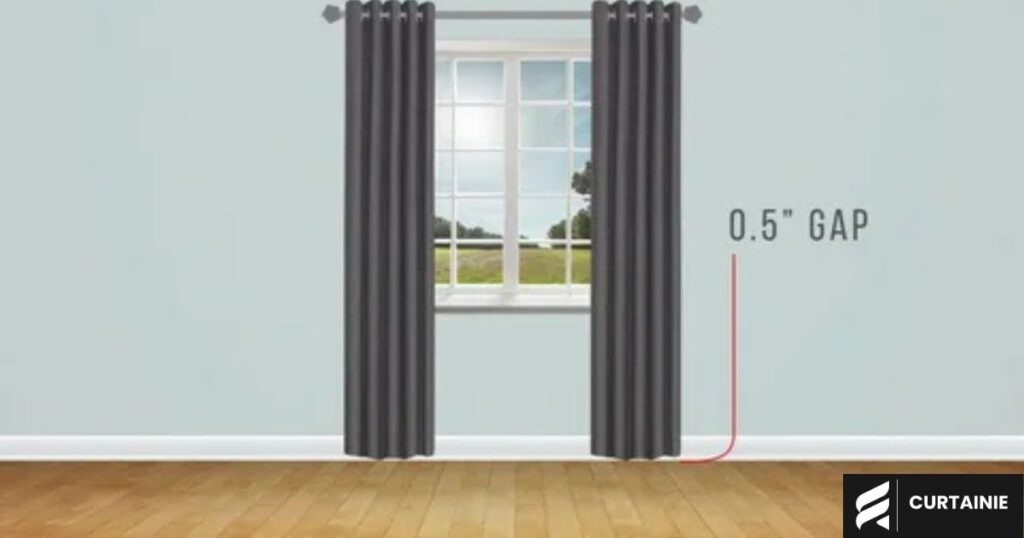
In the United States, retail curtains generally come in a few standard lengths: 84 inches, 96 inches, 108 inches, and 120 inches.
When dealing with a 10-foot ceiling, you must completely avoid 84-inch curtains. They are simply too short and will force you to mount the rod directly on the window frame, ruining the room’s proportions.
Here is how to choose the right standard length based on your mounting strategy:
- 120-Inch Panels: Buy these if you want to hang your rod at the very top of the wall (just below the ceiling). This is the best choice for achieving a high-end, custom aesthetic.
- 108-Inch Panels: Buy these if you are using the “Halfway Mark” strategy. If you mount your rod roughly 12 inches below the ceiling, a 108-inch panel will gracefully reach the floor.
- 96-Inch Panels: These should only be used on a 10-foot ceiling if you have very large transom windows that leave minimal wall space, or if you are deliberately choosing a lower mount for a specific architectural reason. Generally, 96-inch panels are better suited for 8-foot or 9-foot ceilings.
The Bottom Edge: How Should Curtains Meet the Floor?
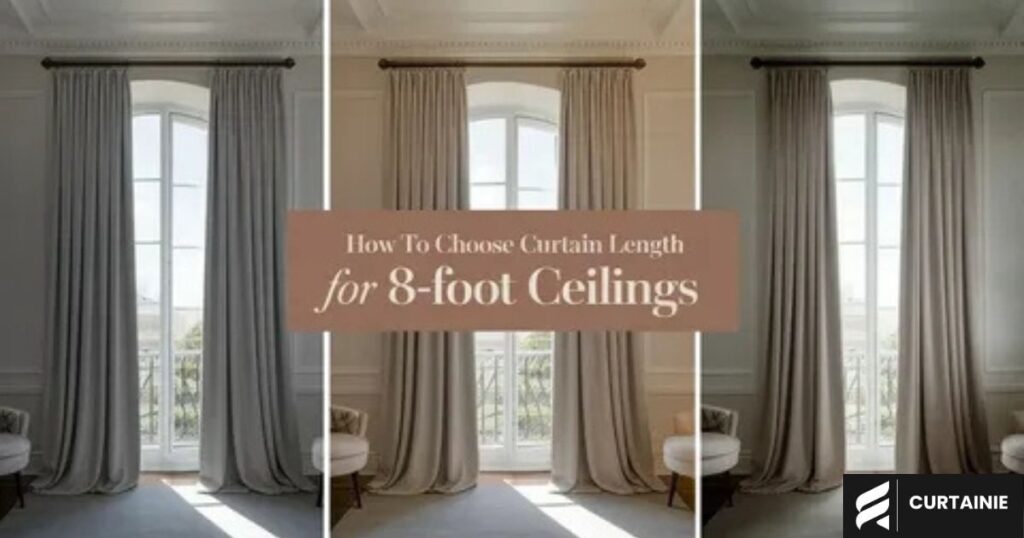
Once you have decided how high to hang the rod, you need to consider where the fabric will end. The relationship between the hem of your curtain and the floor drastically impacts the room’s vibe.
- The Hover (Clearance): The curtains hang exactly 1/2 inch above the floor. This is a clean, tailored look that is incredibly practical. It prevents dust bunnies from gathering on your fabric and makes vacuuming easy.
- The Kiss (Touching): The curtains literally just graze or “kiss” the floor. This is the most professional, bespoke look, but it requires precise measurements and perfectly level floors.
- The Puddle (Breaking): The curtains extend 2 to 6 inches onto the floor, creating a romantic, luxurious “puddle” of fabric. This works beautifully in formal dining rooms or low-traffic master bedrooms, but requires constant adjusting and frequent cleaning.
Pro Tip: If you are buying standard 120-inch curtains and your rod is mounted at 118 inches, you will naturally get a 1-to-2-inch puddle. If you prefer the “Hover” look, you will need to use hemming tape or take the panels to a local tailor.
Don’t Forget the Width: The Overlooked Secret
We have discussed how high to hang curtains, but how wide you hang them is equally important. If your curtains only cover the window frame, they block natural light when open and make the window look narrow.
To maximize your space, follow the “High and Wide” rule:
- Extend your curtain rod 8 to 12 inches beyond the outside edge of the window trim on both sides.
- When your curtains are pushed entirely open, the inner edge of the fabric should just barely overlap the window frame.
- This trick makes the window look massive and ensures that 100% of the natural light can enter the room.
To make this work, ensure you buy enough curtain panels. A good rule of thumb is that the combined width of your curtain panels should be 2 to 2.5 times the width of the window. For example, if your window is 50 inches wide, you need at least 100 to 125 inches of total curtain fabric (usually two 50-inch panels per side).
Essential Tools for a Perfect Installation
To hang curtains on a 10-foot ceiling like a professional, make sure you have the right tools ready before you start drilling into your drywall.
- Steel Measuring Tape: A standard 25-foot tape measure is required to measure from ceiling to floor accurately.
- Laser Level or Long Bubble Level: Walls and ceilings in houses are rarely perfectly straight. Always use a level to ensure your rod is straight, rather than just measuring from the ceiling down.
- Step Ladder: You will need a sturdy 6-foot or 8-foot ladder to reach the top of a 10-foot wall comfortably.
- Stud Finder & Heavy-Duty Anchors: Curtains that are 108 or 120 inches long can be incredibly heavy, especially if they are velvet or blackout lined. If you cannot drill directly into a wall stud, you must use high-quality drywall anchors (like toggle bolts) to prevent the rod from ripping out of the wall.
- Power Drill: For pre-drilling holes and securing the brackets.
Read More ; how high to hang curtains 10 foot ceiling
FAQs
1. What size curtains do I need for a 10-foot ceiling? You will typically need 108-inch or 120-inch curtains, depending on how close to the ceiling you mount the rod.
2. Can I use 96-inch curtains on a 10-foot ceiling? It is not recommended, as it forces you to hang the rod too low, making the ceiling feel disproportionately heavy.
3. How far from the ceiling should I hang the curtain rod? For the most dramatic and luxurious look, hang the rod exactly one to three inches below the ceiling line.
4. Should the bottom of the curtains touch the floor? Yes, designers recommend that curtains should either gently “kiss” the floor or hover exactly half an inch above it.
5. How far past the window should the rod extend? The curtain rod should extend about 8 to 12 inches beyond the window frame on both sides to make the window appear larger.
Conclusion
Decorating a room with 10-foot ceilings is an incredible opportunity to showcase the grandeur and architectural beauty of your home. The secret to achieving a professional, designer-approved look lies entirely in how you manipulate the vertical space. By stepping away from the window frame and utilizing the full height of your walls, you can instantly make your room feel more spacious, luxurious, and perfectly balanced.